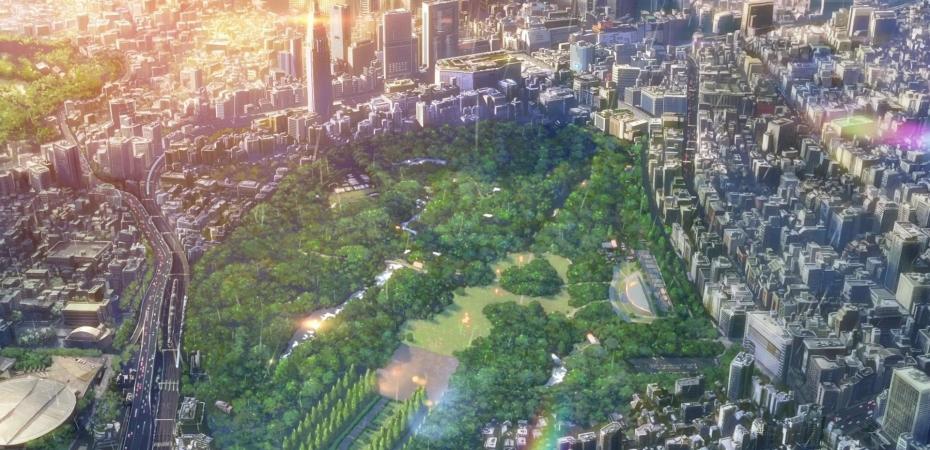
The Garden of Words is Writer / Director Shinkai Makoto’s 2013 film about an aspiring shoe-maker and high school teacher that meet in Shinjuku Gyo-en National Park during the rainy season and strike up a unique relationship, albeit seemingly a touch one-sided.
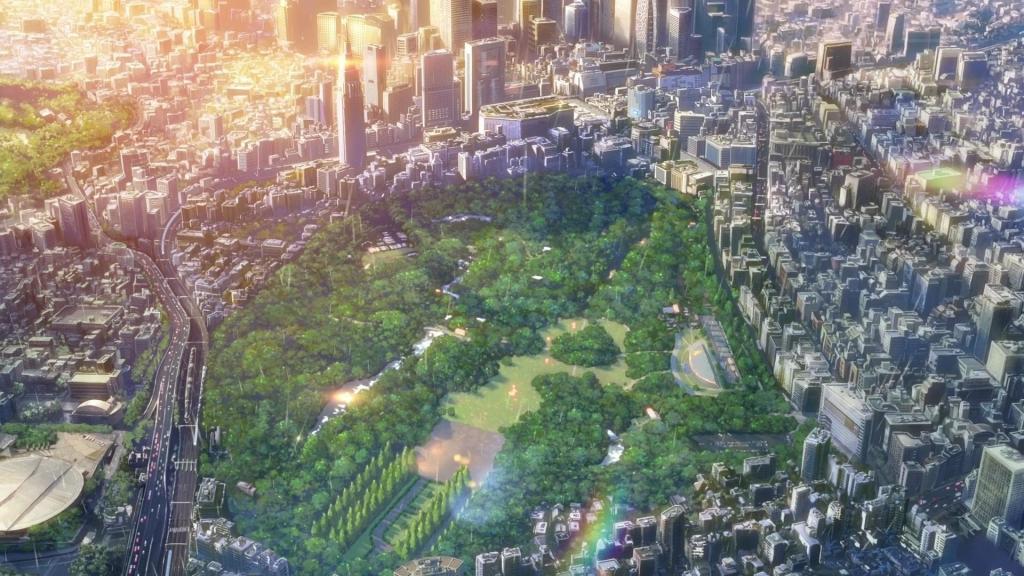
Shinkai is also the writer / director of 2019’s Weathering with You (and the immensely popular 2016 film: Your Name). Both, The Garden of Words and Weathering with You, are beautifully animated with particular attention to the countless subtleties of light and rain, with the weather itself acting as a central character. As in Weathering with You, the use of clear umbrellas, puddles, hundreds of individual drops of rain, and the shimmering reflections ~ all of which are stunningly complex to animate realistically ~ add to the depth of the world and enhance the lifelike feel.
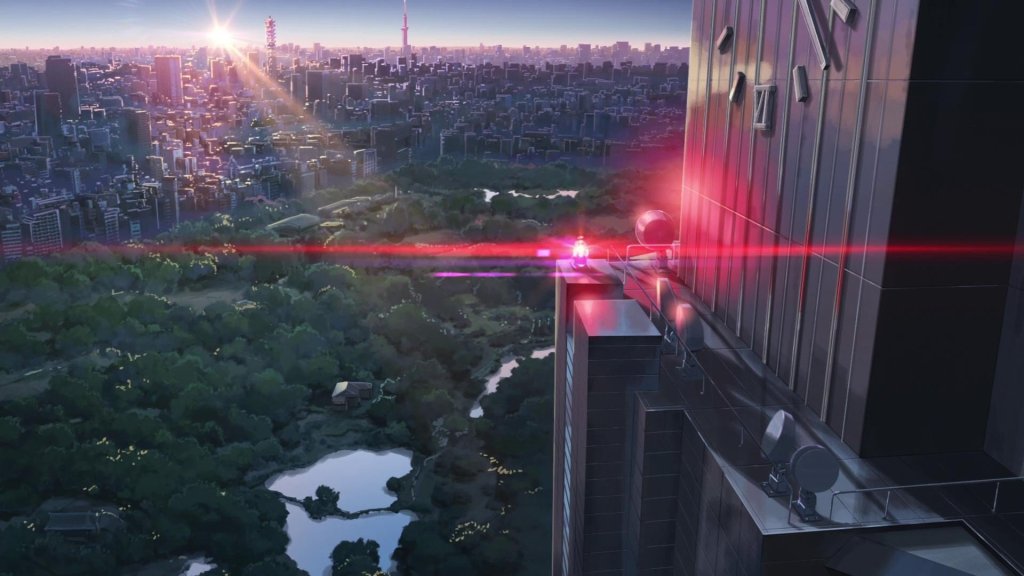
The cityscapes are magnificent and as striking as if they were drawn photographs. Little details like the aircraft warning lights on buildings and traffic signals working as in the real world as the camera pans around the city during narration scenes go a long way to immerse the viewer in the action and portraying the animated story as one that we can see in this world we live in.
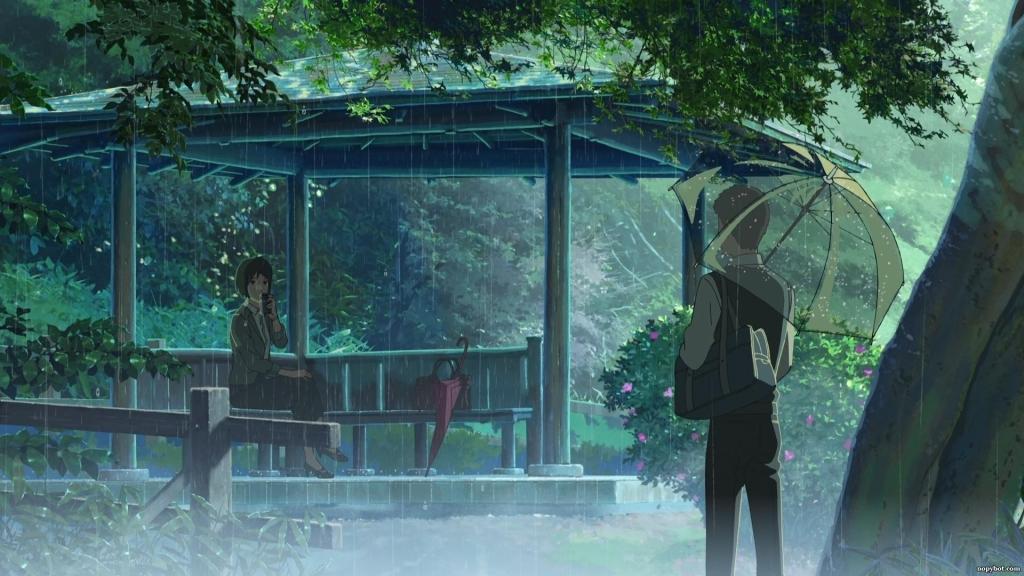
This film centers on two main characters, the young aspiring shoe maker Akizuki Takao (15) who skips classes on rainy days to retreat into the park and sketch designs in his notebook, and a mysterious young woman he meets in the park, Yukino Yukari (27). Throughout the first 2/3 of the film, we, like Takao, learn very little about Yukino, who is revealed to be a teacher from Takao’s school, though she doesn’t show up to work very often, following the fallout of rumors and bullying started by her upperclassmen students. Though the narration doesn’t delve into the nature of the rumors, we learn that they were severe and reached her parents in their distant hometown. Additionally, they were bad enough that Yukino’s mental heath devolves to the point of her developing a taste disorder and skipping work to hide in the park, enjoying a power-breakfast of the only things that have any taste for her: chocolate and beer. (Unrelated, I’m currently drinking Thristy Dog’s Twelve Dogs of Christmas, as this is being watched and written.)
Shinkai is a master at pacing and world-building, with this short film being much more satisfying and expository than traditional feature-length films. The range of themes and emotions captured and explored is staggering for the length of this work. Every scene builds the story and adds something of value to the audience’s understanding of the characters and narrative.
Let’s backtrack to the elephant in the room ~ Yukino (27) and Takao (15). Shinkai said he wanted to show to his audience that aging and maturity aren’t the straight trajectory they’re often thought of; that he understands and relates to Yukino from when he was 27, confused and unsure of a path in life. In the narration, Takao points out that he doesn’t know anything about Yukino ~ her name, where she works (or should be, if she weren’t skipping), or even her age.
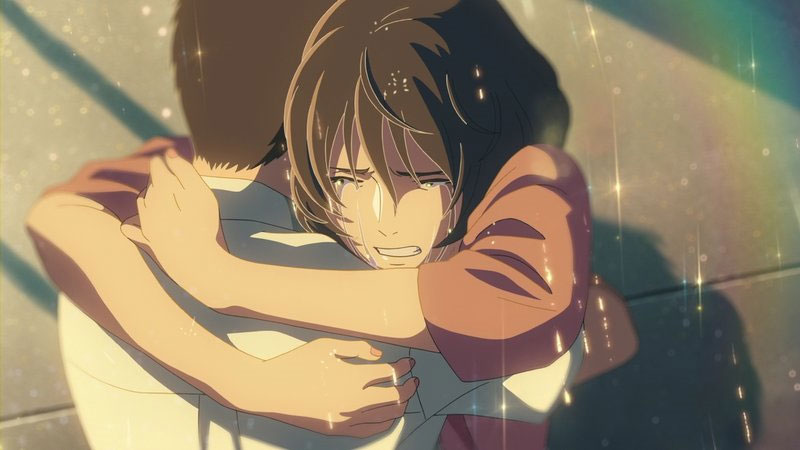
Despite finally learning Yukino’s profession and age, Takao still confesses that he’s fallen in love with her. She gently rejects this by correcting his informal reference to her as “Yukino” for the more formal “Miss Yukino” (I would imagine the original Japanese makes use of an honorific such as “Sensei” or “-sama” here to denote this), where Takao realizes his mistake and leaves. Confusingly, we cut to Yukino’s thought montage of their time together and follows her running, and tripping over herself, from her apartment to chase after Takao. As this transitions to the final scene, she catches up with Takao, who unloads with both barrels and harshly throws the age difference in her face as he accuses her of just humoring the ‘child’ who doesn’t know any better. Yukino, unable to answer his accusations of being a silent listener, unwilling to share anything of herself, throws herself into a crying embrace with Takao. Finally finding her words, she tries to explain that he’s wrong, that he taught her how to ‘walk’ again and that their relationship is important to her, and unspoken, that it’s just not the romantic relationship he’s mistakenly interpreted it as.
Post credits, there’s a final summary narration ~ Yukino returns to her hometown to teach there, Takao manages to graduate high school, completes the pair of shoes he designed for her, and vows to find her when he’s established himself as a cobbler, ostensibly to rebuild their platonic relationship.
Aging and maturing, and not necessarily in a strictly linear pattern, is a major theme of this film, highlighted by the age difference and the places in their lives both main characters find themselves. The different definitions of ‘love’ is also a theme here, as well as the pervasiveness of rain and the seasons (which is integral in Shinkai’s later Weathering With You).
Viewers are likely to recognize the variations of ‘love’ being portrayed here. Takao, aspiring to a non-traditional career path ~ something as (perceived) archaic as being a cobbler ~ coming from a seemingly unsupportive family, and lacking close friends, is intensely drawn to Yukino as she listens to him and supports his creative endeavor and passion. Yukino, buried in the rumors and harassment that led her to Shinjuku Gyo-en, is drawn to someone who is open with her, non-judgemental (beyond jokingly pushing back on her beer and chocolate breakfasts), and doesn’t see her as just the woman from those rumors.
Takao and Yukino both, unaccustomed to this level of acceptance form a relationship centered on said acceptance, which inevitably is misinterpreted by one of them (spoiler, it’s me Takao). Takao, understandably attracted to Yukino (portrayed as not only attractive, but very fashionable, down to her stylish shoes) mistakes these feelings for romantic love, when really it’s a platonic love. Yukino’s love was purely platonic as she was appreciative of Takao’s ability to drag her out from her isolation and help her to once again find a connection with someone. Their separations through the mid-film dry season and during the credits, after Yukino returned home, both give them time apart to reflect and better understand the feelings they have, and seems to bring a clarity to their understandings of the relationship they share.
In all, this is a film that I highly recommend for several reasons:
- It’s beautifully illustrated and animated
- It’s short ~ weighing in at a mere 45min, it can be watched in the same time as a single episode of a show with hour-long episodes
- The characters are well-written, three-dimensional, relatable, and flawed
- There’s a lot of room for interpretation and seeing parts of oneself in the characters
- The soundtrack adds to the film without being distracting
- It shows there’s no ‘one right way’ to mature, handle adversity, form relationships, or handle one’s feelings
- It has the potential to rouse a curiosity in the tanka form of traditional Japanese poetry
It’s a film I’ve re-watched several times, often for different reasons with each viewing, and is becoming a comforting ‘classic’ in my repertoire.

